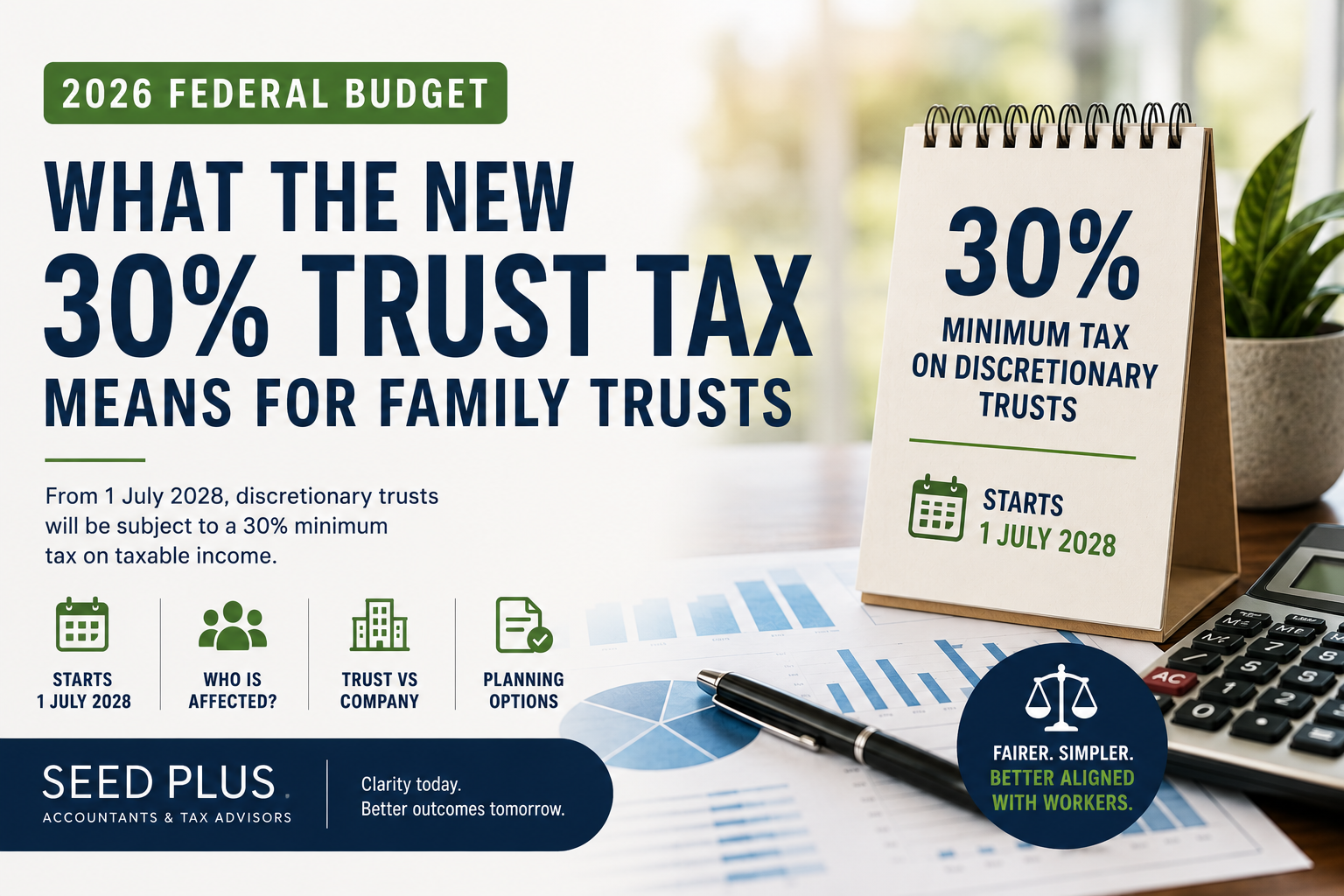
The 2026 Australian Federal Budget introduced one of the most significant changes to trust taxation in decades:
30% trust tax Australia measure that imposes a minimum 30% tax on discretionary trust income from 1 July 2028.
For many Australian small business owners, investors, and families using discretionary trusts, this reform could substantially change how trust income is taxed and may prompt a review of existing structures.
If you operate through a family trust, this article explains what the new rules mean, who is likely to be affected, and what actions you should consider now.
What Is the New 30% Trust Tax Australia Measure?
Under the 2026 Federal Budget, the Government will introduce a 30% trust tax Australia rule applying to discretionary trusts.
From 1 July 2028:
- The trustee will pay a minimum tax of 30% on the taxable income of the trust (unless a higher tax rate already applies).
- Beneficiaries will still include trust distributions in their tax returns.
- Individual and other non-corporate beneficiaries will receive non-refundable tax credits for tax already paid by the trustee.
- Corporate beneficiaries will not receive these credits.
The Government says the objective is to improve fairness by reducing the tax advantage of income splitting through discretionary trusts.
Why the Government Introduced the 30% Trust Tax Australia Rules
Discretionary trusts are commonly used for:
- Asset protection
- Succession planning
- Income distribution flexibility
However, they also allow trustees to allocate income to beneficiaries on lower marginal tax rates.
According to Treasury:
- Australia has more than 1 million trusts
- Around 840,000 (80%) are discretionary trusts
- In 2022–23, discretionary trusts distributed $142.4 billion
- Families using discretionary trusts paid tax rates approximately 4 percentage points lower than similar families without trusts
Who Will Be Affected by the 30% Trust Tax Australia Changes?
The rules apply to most discretionary trusts, including many family trusts used by:
- Small business owners
- Property investors
- Professionals
- High-income families
Treasury estimates:
- Around 810,000 adults received discretionary trust distributions in 2022–23.
- Around 350,000 active small businesses operate through discretionary trusts.
- More than 95% of individual taxpayers are not expected to be affected in any given year.
- Around half of discretionary trusts are not expected to pay additional tax annually.
Which Trusts Are Excluded?
The new minimum tax will not apply to:
- Fixed trusts
- Widely held trusts
- Complying superannuation funds
- Special disability trusts
- Deceased estates
- Charitable trusts
Certain income is also excluded, including:
- Primary production income
- Certain income relating to vulnerable minors
- Income subject to non-resident withholding tax
- Existing testamentary trust asset income
How the 30% Trust Tax Australia Rules Work in Practice
Example: Family Income Splitting
Treasury’s example shows Steven earning $200,000 through a discretionary trust.
He distributes $50,000 each to himself and three family members with no other income.
Current Rules
Total family tax: $24,008
If Steven Earned the Income Personally
Tax payable: $59,602
Under the New 30% Trust Tax Australia Rules
Minimum tax on $200,000: $60,000
Steven’s family effectively loses the benefit of income splitting.
Impact on Small Business Owners
Many small businesses use family trusts to distribute profits to spouses and adult children.
Under the new rules:
- Salary and wages paid to family members working in the business remain deductible.
- Retained trust income and distributions to low-tax beneficiaries may attract the 30% minimum tax.
- Businesses may need to reassess whether a trust remains the most efficient structure.
Treasury notes that more than 90% of all small businesses are not expected to be affected in any given year.
What Happens to Bucket Companies?
A common strategy is to distribute income to a corporate beneficiary (often called a bucket company) taxed at the company rate.
Under the new rules:
- The trustee pays the 30% minimum tax.
- Corporate beneficiaries do not receive tax credits for that tax.
- The Government intends to prevent trusts from avoiding the minimum tax by cycling income through a company.
This means bucket companies may become less attractive for discretionary trust tax planning.
Should You Restructure Your Trust?
The Government will provide expanded rollover relief for taxpayers who restructure out of discretionary trusts into other structures such as:
- Companies
- Fixed trusts
The relief will be available for three years from 1 July 2027, allowing tax-neutral restructuring without triggering capital gains tax or other income tax consequences.
Trust vs Company: Which Structure May Be Better?
Small businesses restructuring to a company may benefit from:
- The 25% small business company tax rate
- Dividend imputation
- Easier profit retention
- Better access to debt and equity funding
The lower company tax rate applies where:
- Aggregated turnover is less than $50 million, and
- No more than 80% of assessable income is passive income.
For some businesses, this may make a company structure more attractive than a family trust.
| Date | Change |
|---|---|
| 1 January 2027 | Australian Small Business and Family Enterprise Ombudsman begins support |
| 1 July 2027 | Rollover relief period starts |
| 1 July 2028 | 30% minimum tax on discretionary trusts begins |
What You Should Do Now
1. Review Your Current Trust Structure
Understand how your trust distributes income and whether beneficiaries currently pay less than 30% tax.
2. Model Future Tax Outcomes
Compare tax outcomes under current rules versus the new 30% trust tax Australia measure.
3. Assess Your Bucket Company Strategy
Review whether corporate beneficiaries still make sense.
4. Consider Restructuring Options
Determine whether moving to a company or fixed trust may be beneficial.
5. Get Advice Before the Rules Start
Early planning can avoid rushed decisions once legislation is finalised.
Frequently Asked Questions
Will all family trusts pay more tax?
No. Treasury estimates around half of discretionary trusts will not be affected in any given year.
Does the tax start immediately?
No. The rules are proposed to start from 1 July 2028.
Can I still use a bucket company?
Yes, but the tax benefit may be significantly reduced.
Can I restructure without CGT?
Potentially yes, with rollover relief available for three years from 1 July 2027
Final Thoughts on the 30% Trust Tax Australia Changes
The new 30% trust tax Australia rules represent a major shift in how discretionary trusts are taxed.
While many trust users may not face additional tax, anyone relying on income splitting, bucket companies, or trust-based small business structures should review their position well before 1 July 2028.
The good news is that there is time to plan, and rollover relief may allow restructuring without immediate tax consequences.
Need Advice on the 30% Trust Tax Australia Changes?
At SEED PLUS, we help Australian business owners and investors understand complex tax changes and implement practical strategies.
Whether you need:
- Trust tax planning
- Family trust reviews
- Business restructuring
- Tax advisory services
our team can help you assess the impact of the new rules and develop a tailored plan.
Disclaimer
This blog provides general information only and should not be relied upon as specific advice for your circumstances. Tax and accounting regulations are complex and subject to change. Every business situation is unique, and the right approach depends on your specific circumstances.
Before making any decisions about your PAYG instalments or other tax matters, you should consult with qualified accounting and tax professionals who can assess your individual situation and provide advice tailored to your needs.
The information in this blog is current as of the publication date and is based on Australian Taxation Office guidelines and Australian accounting standards. However, tax laws and regulations change regularly, and you should verify that the information remains current before acting on it.
Get Professional Support
Contact SEED PLUS today! Let’s make your business shine, not just in profits, but in positive impact on the society, environment and economy too.
Contact our office: (03) 6153 0180 to discuss your scenario.