Your Business Needs Consolidated Reporting
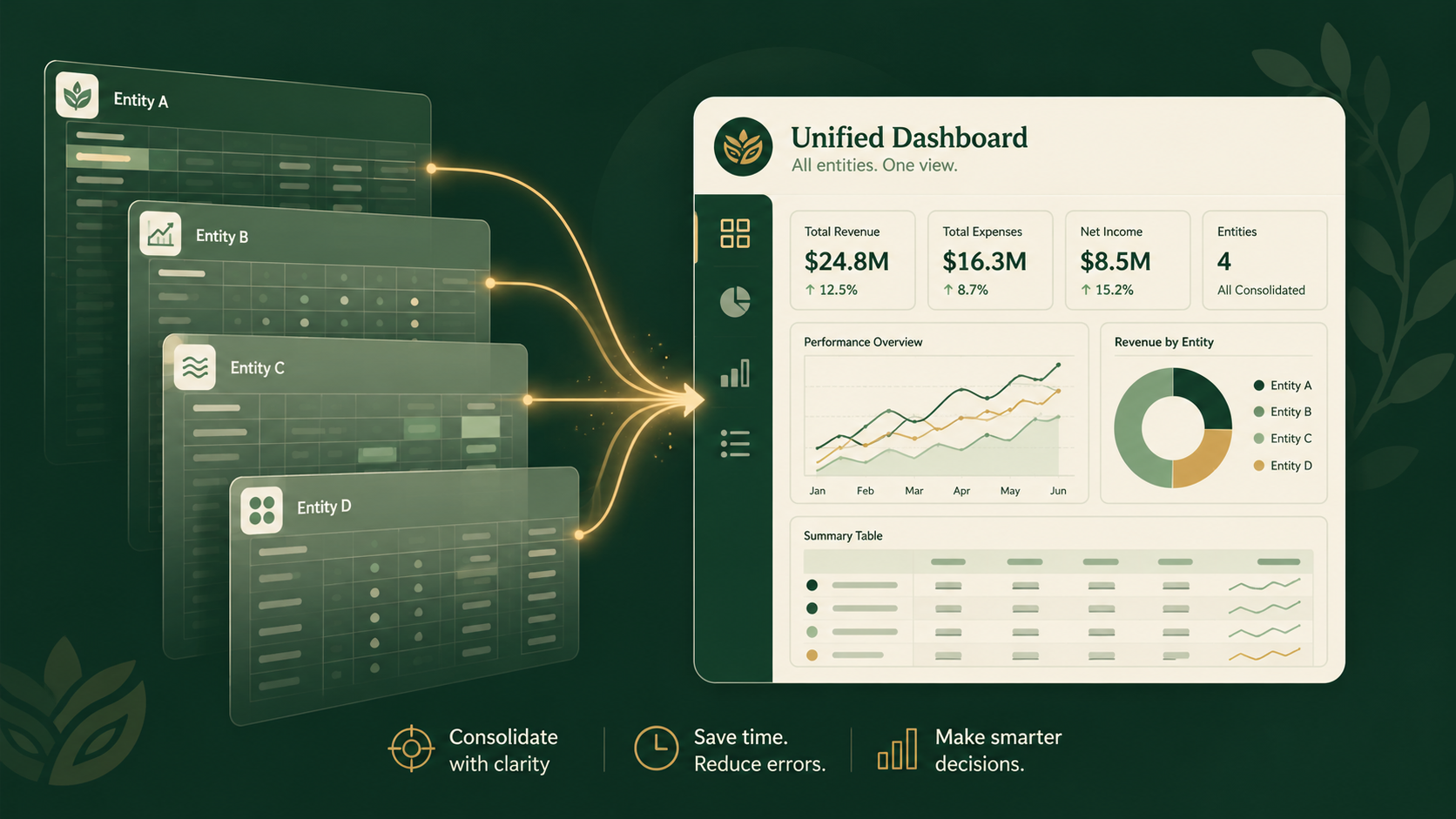
Your business now operates through more than one company, trust, or related entity, and you are still preparing a separate set of financial reports for each one, you have probably outgrown single entity bookkeeping. Consolidated Company Reportings brings the numbers from every related entity together into one accurate group picture, removing double counted transactions between entities and giving owners and finance teams a true view of overall performance. Most businesses reach this point well before anyone officially decides it is time to change, usually not long after a second trading entity, a property trust, or a new subsidiary has quietly been running for a year or two.
This piece walks through what consolidated reporting actually involves, the signs that your business needs it, and what the process looks like once you commit to building it properly.
What Consolidated Company Reportings Actually Means
Consolidated reporting combines the profit and loss and balance sheet of two or more related entities into a single set of financial statements, as though the group were one business. Under Australian Accounting Standards, this is formally addressed in AASB 10 Consolidated Financial Statements, which sets out when one entity controls another and therefore needs to be included in a group set of accounts.
In practice, for privately owned groups this is less about strict statutory compliance, which typically only applies once certain size or reporting thresholds are met, and more about management need. A business with related entities needs to see its true combined position long before any formal consolidation obligation arrives, because lenders, boards, and owners all make decisions based on the group, not on any single entity in isolation.
The mechanics involve two things done properly: standardising how each entity records its transactions, and then eliminating the transactions that happen between related entities, so that money moving from one entity to another is not counted as both an expense in one business and revenue in the next.
Five Signs Your Business Has Outgrown Single Entity Bookkeeping
1. You are combining reports manually every month. If someone on your team, or you, is exporting profit and loss reports from two or three separate Xero files and pasting them into a spreadsheet to get a combined figure, that is consolidated reporting being done by hand, without the eliminations that make it accurate. It is time consuming, prone to error, and gets harder every time a new entity is added.
2. Intercompany loans and charges are hard to track. Once one entity is paying expenses on behalf of another, or lending money between related companies, those balances need to be tracked precisely. A common warning sign is when nobody can say with confidence exactly how much one entity owes another as at the end of the month, or the intercompany loan account has not been reconciled in over a year.
3. You cannot state your group profit without days of work. If a lender, prospective investor, or your own board asks what the group actually made this year, and the honest answer involves several days of reconciliation before anyone can answer confidently, that is a strong sign the reporting structure has not kept pace with the business structure.
4. Each entity runs on a different chart of accounts. When entities were set up at different times, often by different bookkeepers or accountants, it is common to find that each one categorises the same type of transaction differently. Consolidation only works cleanly once every entity is mapped to a shared chart of accounts, so figures can genuinely be added together rather than approximately combined.
5. A bank, investor, or grant body has asked for a consolidated position. Lenders assessing a facility across a group, prospective investors doing due diligence, or funding bodies reviewing a related structure will usually ask for consolidated figures at some point. If that request has already landed and caused a scramble, this is the clearest sign that consolidated reporting needed to exist before it was asked for, not after.

An example of A Growing Trades and Property Group
To make this concrete, consider a composite example drawn from the type of business Seed Plus works with regularly, not a specific named client. A family owned trades business started as a single operating company. Over several years, the owners added a property holding trust to own the premises, then established a second trading entity to separate a new service line. Revenue across the group grew from around two million dollars to six million dollars over three years, but the reporting structure never changed. Three separate Xero files, three different charts of accounts, and an intercompany loan account between the operating company and the trust that had not been reconciled in eighteen months.
Once the group moved to consolidated reporting, two things became clear almost immediately. First, the true group profit margin was noticeably different from what the operating company alone had suggested, because a significant portion of profit was effectively being absorbed by unreconciled intercompany charges. Second, the property trust was carrying a much larger loan balance from the operating company than anyone had realised, which mattered directly for how the owners were thinking about a future refinance. Neither issue was a crisis. Both were the kind of thing that consolidated reporting exists to surface early, while there is still time to plan around it.
What are the steps of Creating Complex Company Consolidation Reports
Building consolidated reporting as per the standards for the first time generally involves:
- Standardising the chart of accounts across every entity, so the same transaction type is categorised the same way regardless of which entity it sits in.
- Identifying and eliminating intercompany transactions and loans, so revenue and expenses that occur between related entities are removed from the group total rather than counted twice.
- Consolidating profit and loss and balance sheet reporting into one set of statements that reflects the group as a single economic unit.
- Building a group level cash flow forecast, since cash sitting in one entity is not necessarily available to fund another without a deliberate intercompany transfer.
- Setting a reporting cadence, usually monthly or quarterly, so consolidated figures are available on a predictable schedule rather than only when someone urgently needs them.
None of this needs to be complicated once it is set up properly. The effort is almost entirely front loaded into getting the structure right the first time; after that, a well built consolidation process should not take materially longer than reporting on a single entity.
Beyond the Compliance: Why This Is a Management Tool, Not Just an Accounting Exercise
It is worth being direct about this: for most privately owned groups, consolidated reporting is not primarily driven by a legal reporting obligation. It is driven by the fact that owners and finance teams cannot make good decisions about a group they cannot see clearly.
Board reporting packs, budget versus actual tracking, and cash flow forecasting all become substantially more useful once they reflect the whole group rather than one entity at a time. Decisions about where to invest, which entity should absorb a new hire, or whether the group can support a new loan, all depend on an accurate group level picture. This is the same reasoning behind Virtual CFO style advisory support: the value is not in producing the reports themselves, but in giving owners a genuine, current view of the business they can act on.
How Seed Plus Approaches Group and Multi Entity Reporting
Seed Plus has worked with growing businesses on group structures for years. As a CPA Australia Public Practice and Xero Gold Partner, Seed Plus builds consolidated reporting structures inside the software clients already use, standardising charts of accounts across entities and setting up the ongoing process so consolidated figures are available on a predictable schedule, not simply create under pressure. For businesses that have outgrown single entity bookkeeping but are not ready for a full time finance hire, this work typically sits alongside Virtual CFO support, so the reporting feeds directly into decisions rather than sitting in a folder.
Think of it as Virtual CFO-style support scaled to what a committee can realistically justify — you get the financial leadership without needing to fund a full-time hire.
What are complex company consolidated reportings?
How many entities before I need consolidated reporting?
Is consolidated reporting only relevant if I am legally required to prepare group financial statements?
Can consolidated reporting be done in Xero, or do I need separate software?
How long does it take to set up consolidated reporting for the first time?
Talk to us today and discuss your company consolidated reportings?
Next Step
If your business is now running through more than one entity and your reporting has not caught up, it is worth having that conversation before a lender, investor, or your own board asks the question first. Visit Seed Plus to talk through what consolidated reporting would look like for your specific structure.
Contact Seed Plus: Phone: (03) 6153 0180 or 0401 455 218 Email: info@seedplus.com.au
At SEED PLUS, we remain committed to supporting growing Australian Business by providing trusted accounting, taxation and business advisory services.
Because when you succeed, Australia succeeds.
How SEED PLUS Can Help
Our experienced team can help you:
- Review your current structure
- Develop tax-efficient strategies based on current legislation
- Strengthen your organisation for long-term growth
- Build a resilient organisation that can adapt to future changes
Contact SEED PLUS today to discuss your business strategy and ensure you’re prepared for whatever comes next.
Partner with SEED PLUS: Your Growth Catalyst
The prosperity of Melbourne depends directly on the strength of its small businesses. At SEED PLUS, our mission is to eliminate the friction of compliance and financial administration, allowing business owners to focus entirely on what they do best: building exceptional companies.
Whether you are an independent small business looking for robust bookkeeping and tax solutions, or a growing accounting practice seeking to scale your capacity through an outsourced partnership, we have the local expertise and infrastructure to guide you.
Take the Next Step in Your Business Journey
Don’t let tedious bookkeeping and complex tax compliance hold your business back from its true potential. Contact our expert team today to align your financial strategies with sustainable growth.
-
Office Location: Suite 600, Waterman Caribbean Park, 44 Lakeview Drive, Scoresby, Victoria 3179
-
Phone Contact: (03) 6153 0180 / 0480 033 518
-
Email Correspondence: info@seedplus.com.au
-
Digital Appointment Booking: Head directly to our [Book Free Consultation] page to schedule a comprehensive financial review with our Melburnian specialists.
Disclaimer
This blog provides general information only and should not be relied upon as specific advice for your circumstances. Tax and accounting regulations are complex and subject to change. Every business situation is unique, and the right approach depends on your specific circumstances.
Before making any decisions about your PAYG instalments or other tax matters, you should consult with qualified accounting and tax professionals who can assess your individual situation and provide advice tailored to your needs.
The information in this blog is current as of the publication date and is based on Australian Taxation Office guidelines and Australian accounting standards. However, tax laws and regulations change regularly, and you should verify that the information remains current before acting on it.
Get Professional Support
Contact SEED PLUS today! Let’s make your business shine, not just in profits, but in positive impact on the society, environment and economy too.
Contact our office: (03) 6153 0180 to discuss your scenario.